입문 · HSK 준비중국어(표준 중국어)
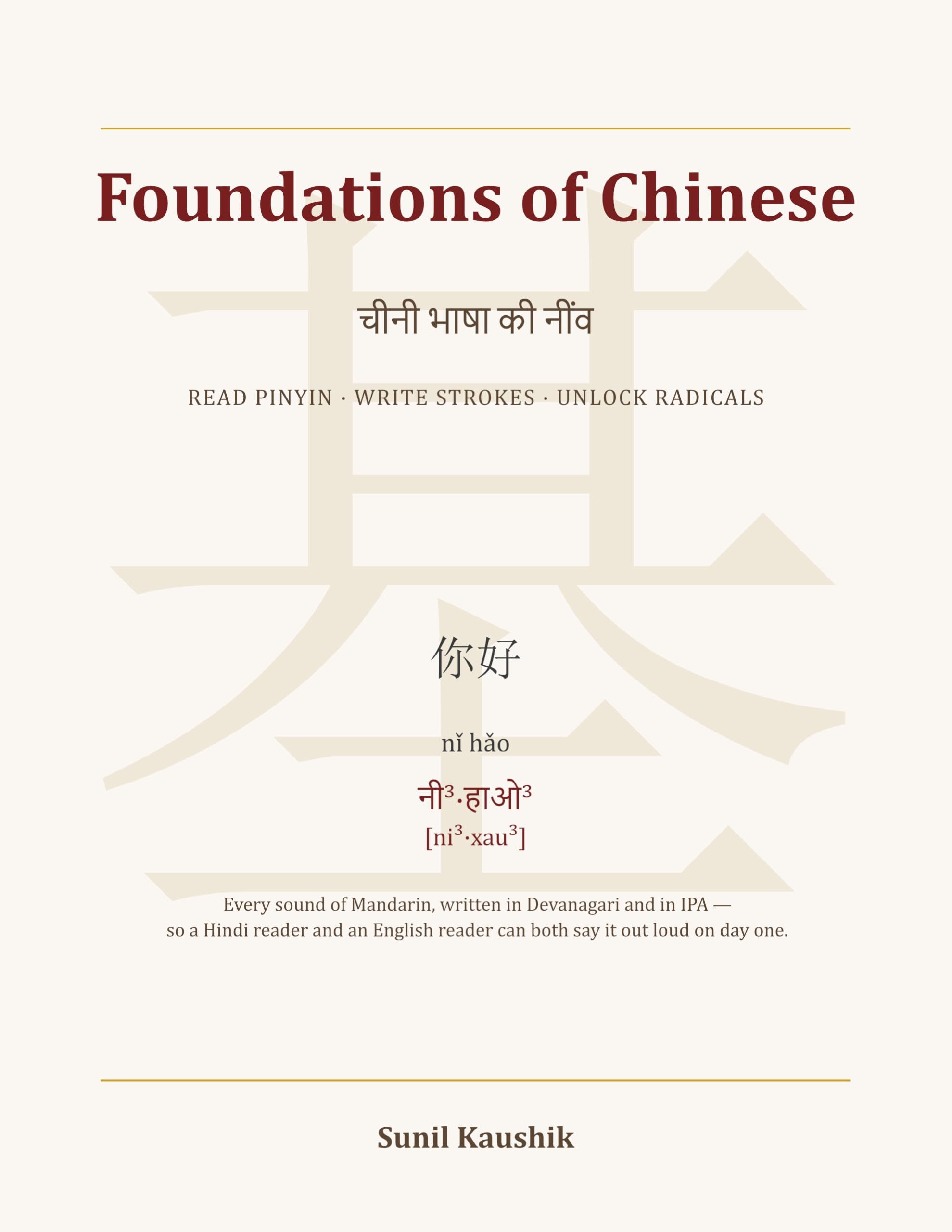
Foundations of Chinese
Read Pinyin, Write Strokes, Unlock Radicals: Mandarin Sounds in Devanagari and IPA, for Hindi and English Readers
“중국어의 소리는 많지 않습니다. 한자는 작은 부품으로 만들어집니다.”
요약
중국어의 소리, 획, 부수를 다루는 입문 가이드. 모든 단어를 병음, 데바나가리 문자, 국제음성기호로 적었습니다: 네 가지 성조, 전체 음절표, 획순 규칙, 그리고 사전을 여는 열쇠인 부수 64개.
Amazon에서 구매
설명은 영어로 되어 있으며, 모든 단어에 데바나가리 문자, 국제음성기호, 힌디어 뜻도 함께 실려 있습니다.
이 책에 담긴 것
- The four tones, the puff pairs, j q x and zh ch sh r — each hard sound with a mouth drawing and a Hindi anchor word.
- The full Mandarin syllable chart (about 400 syllables) on one spread, every one in Devanagari.
- The eight strokes and the seven rules of stroke order, with numbered diagrams and practice grids.
- The 64 radicals that unlock the dictionary, taught in families with stories and drills.
- Answers to every drill, plus a complete pinyin-to-Devanagari reference table.
이 책에 대하여
아래 전체 소개글은 저자가 직접 영어로 쓴 것입니다.
Chinese sounds are few. Chinese writing is built from small parts. This book gives you both, in the order you need them.
Every word in this book carries a line in Devanagari. Pinyin uses Roman letters, but Roman letters trick a Hindi reader: pinyin c is not “k”, pinyin x is not “ks”. Hindi already has the one thing Chinese needs most, the puff of air in ka and kha, ta and tha, pa and pha, and this book uses it. You can read the sounds out loud on day one.
Part A, The Sounds of Chinese. The four tones and the quiet fifth. The puff pairs. The smiling sounds j q x. The curled tongue of zh ch sh r. Every vowel and every ending. Each hard sound comes with a drawing of the mouth, a Hindi word to anchor it, and a sound-alike from Urdu, French or English. The part ends with the full syllable chart of Mandarin on one spread, about 400 syllables, every one written in Devanagari.
Part B, Hanzi Basics. What a character really is, and the myths about it. The eight strokes and the family of turns and hooks. The seven rules of stroke order, with numbered diagrams and practice grids. How characters are built, and how they carry sound.
Part C, The Radicals. The sixty-four radicals that unlock the dictionary, taught in families with stories, worked examples and drills, and a look-up index by stroke count.
Every drill has its answers. Four appendices hold the complete pinyin-to-Devanagari table, the stroke sheet and the radical chart for lifelong reference.
Book 1 of a series that goes on to HSK-level hanzi workbooks and grammar readers, all with the same treatment: hanzi, pinyin, Devanagari and IPA.
이런 분께 추천합니다
중국어 왕초보, 기초를 제대로 다지고 싶은 HSK 학습자, 그리고 영어식 철자로는 중국어 소리가 잘 들리지 않았던 분.
이 시리즈의 다른 책
중국어